PLC Programming
PLC programming is the control software that runs your machines and lines. Mikewill develops Allen-Bradley and Rockwell PLC logic — from ladder and structured routines to full line control, motion, and sequencing — then wires and commissions it in-house so what we write matches how your plant actually runs.
Scope of work
- Allen-Bradley / Rockwell PLC development in Studio 5000, RSLogix 5000, and legacy RSLogix 500
- Ladder logic, function blocks, structured text, and reusable Add-On Instructions
- Full line control: sequencing, interlocks, recipe handling, and station-to-station coordination
- Servo and motion-axis programming for high-speed filling, bagging, and material handling
- EtherNet/IP and device-level networking to drives, robots, vision, and remote I/O
- HMI development alongside the PLC code — PanelView and FactoryTalk View screens built by the same engineer writing the logic, so the tags and the screens never drift apart
- Fault handling, diagnostics, and alarming that tell operators what actually went wrong
- Well-documented, commented code your team can read, maintain, and expand later
Our process
- 01
Understand the process
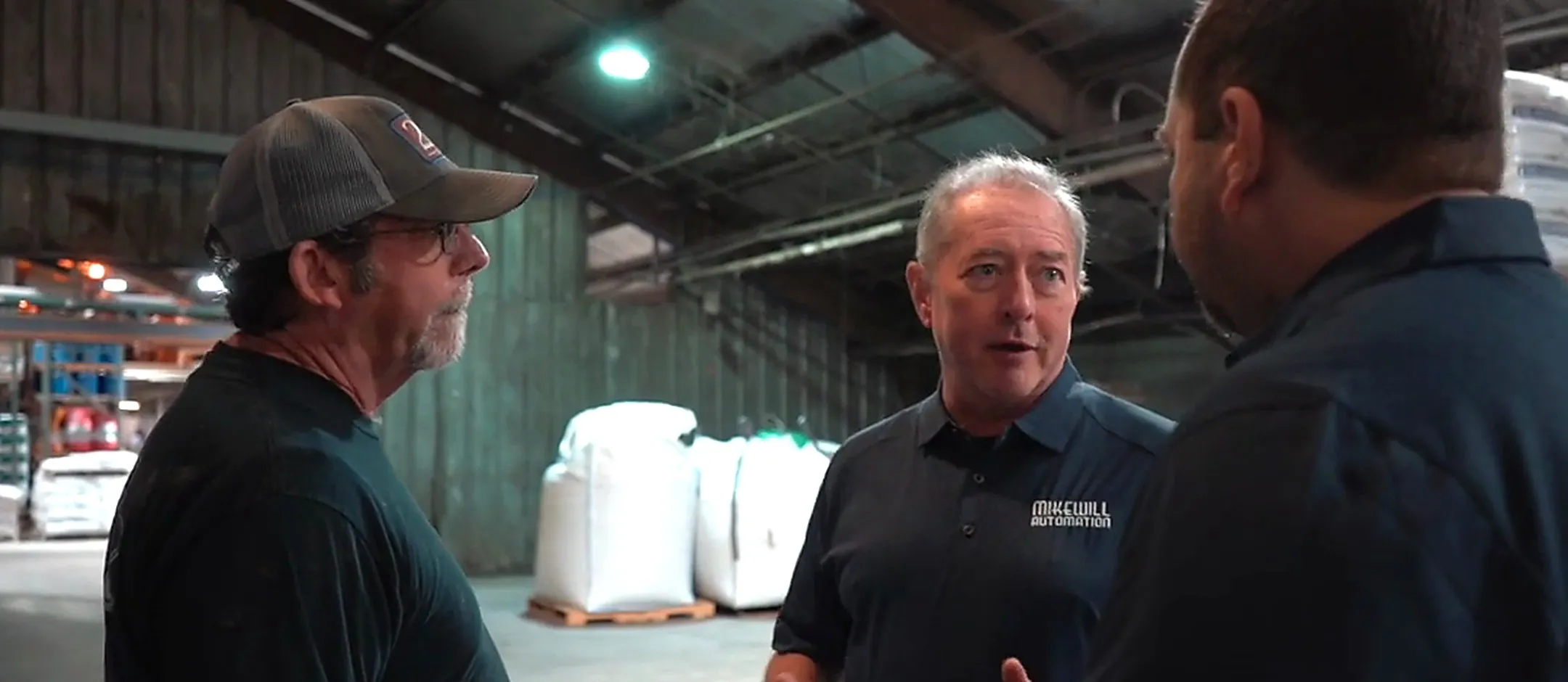
We walk the floor and map the sequence of operations so the logic reflects how your line really runs, not a generic template.
- 02
Architect the control
We define the I/O, networks, and program structure — modular routines and Add-On Instructions that stay clean as the system grows.
- 03
Write and simulate
We develop the PLC code, then test and simulate logic to catch faults and edge cases before anyone touches the machine.
- 04
Wire and commission
Because our own electricians wire the panels, we commission the program against real hardware and tune it live on the floor.
- 05
Document and support
We hand off commented code and drawings, then stay reachable for changes, additions, and troubleshooting down the road.
Related case studies
 Agriculture, Feed & Grain
 Automated Feed Bagging & Palletizing for Tucker Milling
A complete feed-bagging and palletizing line for a leading Southeast feed producer, backed by near-daily on-site engineering support.
 Food & Beverage
 Portion-Pack Automation for Jordan Manufacturing
Precision fillers and dispensers for condiment and packet-sauce portion-pack machines, driven by Allen-Bradley servos and PLC motion profiles.
What PLC brands and software do you program? +
We program primarily Allen-Bradley and Rockwell controllers — ControlLogix and CompactLogix — using Studio 5000 and RSLogix 5000. We also work in legacy RSLogix 500 and SLC 500 platforms, which matters when we upgrade older lines. That focus lets us write clean, reliable logic on the platforms most Southeast plants already run.
Do you only write code, or can you wire and commission the system too? +
Both. Unlike programming-only integrators, our electricians and controls engineers work under one roof. The same team that writes your PLC logic wires the panels and commissions the line, so the code matches the hardware and one accountable partner owns the whole result — no finger-pointing between vendors.
Can you take over or modify PLC programs another integrator wrote? +
Yes. We regularly step into existing Allen-Bradley and Rockwell programs to add features, fix problems, or clean up logic. We start by studying how the current code and machine behave, then make changes carefully and document them, so your team ends up with a program that is easier to maintain than before.
Will we be able to maintain the PLC code after you leave? +
That is the goal. We build modular, well-commented programs using reusable Add-On Instructions and clear tag naming, and we hand off documentation and drawings. Your team can read, troubleshoot, and expand the logic themselves — and we stay reachable when you want us to make changes or add to the system.
Can you program servo motion and high-speed line control? +
Yes. We develop PLC motion-axis profiles and servo logic for high-speed, high-precision work like portion filling, bagging, and coordinated material handling. We tie drives, robots, and vision together over EtherNet/IP so stations stay in sync, then tune the motion live on the floor during commissioning for repeatable, shot-after-shot accuracy.
Ready to talk plc programming?
Get a senior engineer on the phone who can scope your project honestly — and tell you if there's a simpler way.