Controls Engineering
Controls engineering is the design work that decides how your machine or line actually runs — the system architecture, I/O and network layout, control panel design, and PLC logic behind it. Mikewill engineers that foundation so your equipment starts up clean, runs predictably, and keeps running reliably for years.
Scope of work
- Control system architecture — I/O counts, network topology, and how every device on the line talks to the PLC
- Control panel design and layout, with panels built to spec and documented for the people who maintain them
- PLC and motion control design on Allen-Bradley / Rockwell platforms, from sequence of operations to servo coordination
- Electrical schematics, I/O lists, bills of material (BOMs), and network drawings your team can actually troubleshoot from
- Safety circuit and E-stop design integrated into the control system, not bolted on afterward
- Networked controls using EtherNet/IP and industrial protocols to tie PLCs, drives, robots, and vision together
- Because our electrical and controls work happens under one roof, the design that gets drawn is the design that gets wired and programmed
Our process
- 01
Understand the process
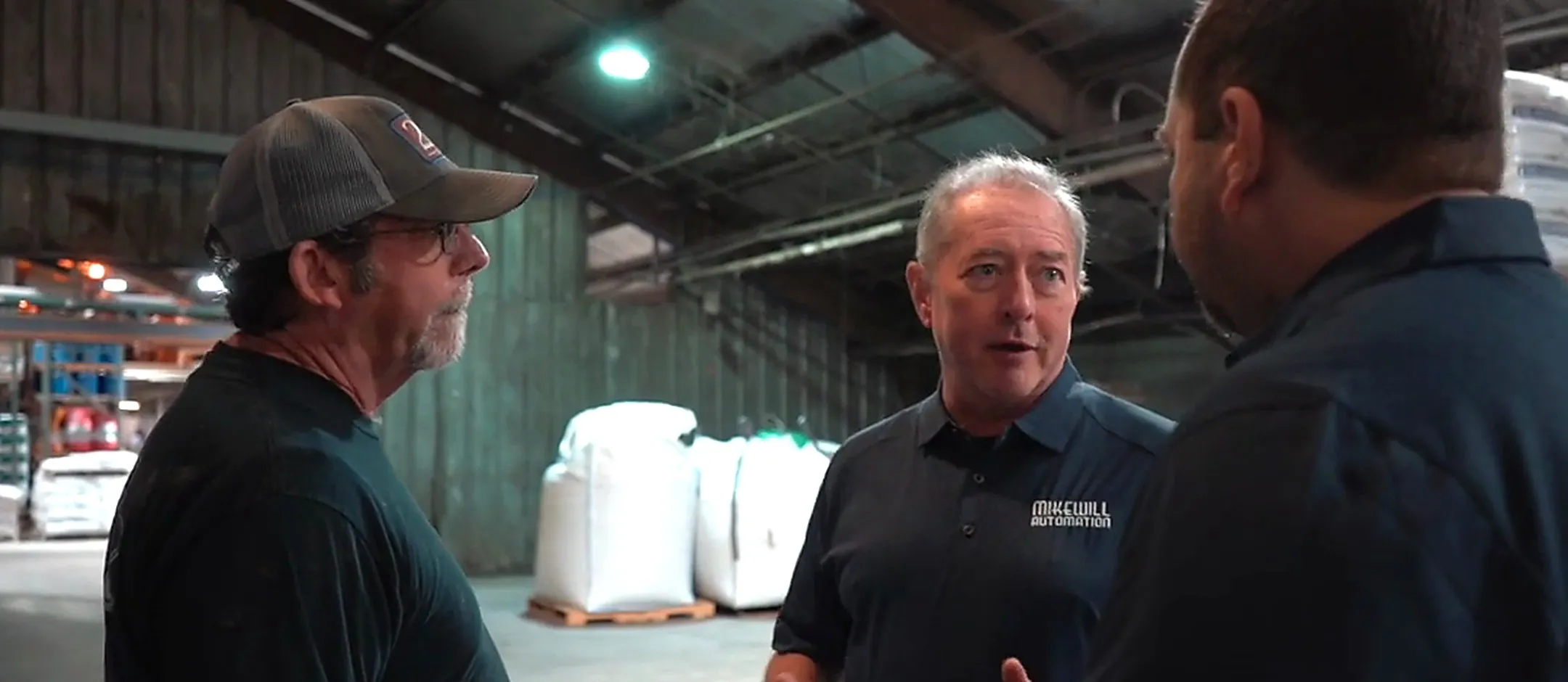
We walk the floor and define the real sequence of operations, throughput targets, and constraints before a single drawing is started.
- 02
Design the architecture
We lay out the PLC platform, I/O, networks, and safety strategy — the backbone every downstream program and panel is built on.
- 03
Draw and specify
We produce electrical schematics, panel layouts, and I/O documentation detailed enough to build, wire, and maintain from.
- 04
Build and program
Our in-house electrical and controls teams build the panels to spec and develop the PLC logic against the design.
- 05
Commission and hand off
We start the system up, tune it in production, and leave your team accurate as-built documentation so the design serves you for years.
Related case studies
 Metals & Steel
 10+ Robotic Weld Cells for Delta Steel & Tube
More than ten robotic weld cells — mixing ABB and FANUC robotics with vision-based quality checks — for a high-volume steel tubing manufacturer.
 Food & Beverage
 Portion-Pack Automation for Jordan Manufacturing
Precision fillers and dispensers for condiment and packet-sauce portion-pack machines, driven by Allen-Bradley servos and PLC motion profiles.
What's the difference between controls engineering and PLC programming? +
Controls engineering is the design layer — system architecture, I/O and network layout, panel design, and how the whole line is meant to run. PLC programming is writing the logic that executes that design. You need both, and doing the engineering first is why the finished system runs reliably instead of getting patched into shape.
Do you design the control panels too, or just the logic? +
Both. We handle the full control system — architecture, electrical schematics, and panel design — and our in-house electrical team builds those panels to spec. Because one company designs, wires, and programs the system, the drawings match the panel and the panel matches the code, which is where a lot of integrators lose the thread.
Which PLC platforms do you engineer controls on? +
We work primarily on Allen-Bradley / Rockwell — ControlLogix and CompactLogix with Studio 5000 — plus Allen-Bradley servo and motion control. We tie those PLCs to ABB and FANUC robots, Keyence vision, and drives over EtherNet/IP so the whole line runs as one coordinated, networked control system.
Can you engineer controls for an existing machine, not just a new line? +
Yes. A lot of our controls work is on equipment that already exists — re-architecting the control system, redesigning panels, and adding motion or networking to older machines. We map the current process first, then engineer improvements that fit the plant you have instead of forcing a full rebuild.
Will we get documentation we can actually maintain the system from? +
Yes. You get accurate electrical schematics, I/O lists, network drawings, and as-built documentation reflecting what was really installed. That's the point of doing the engineering properly — your team can troubleshoot, extend, and support the system for years without having to reverse-engineer it or call us for every question.
Ready to talk controls engineering?
Get a senior engineer on the phone who can scope your project honestly — and tell you if there's a simpler way.